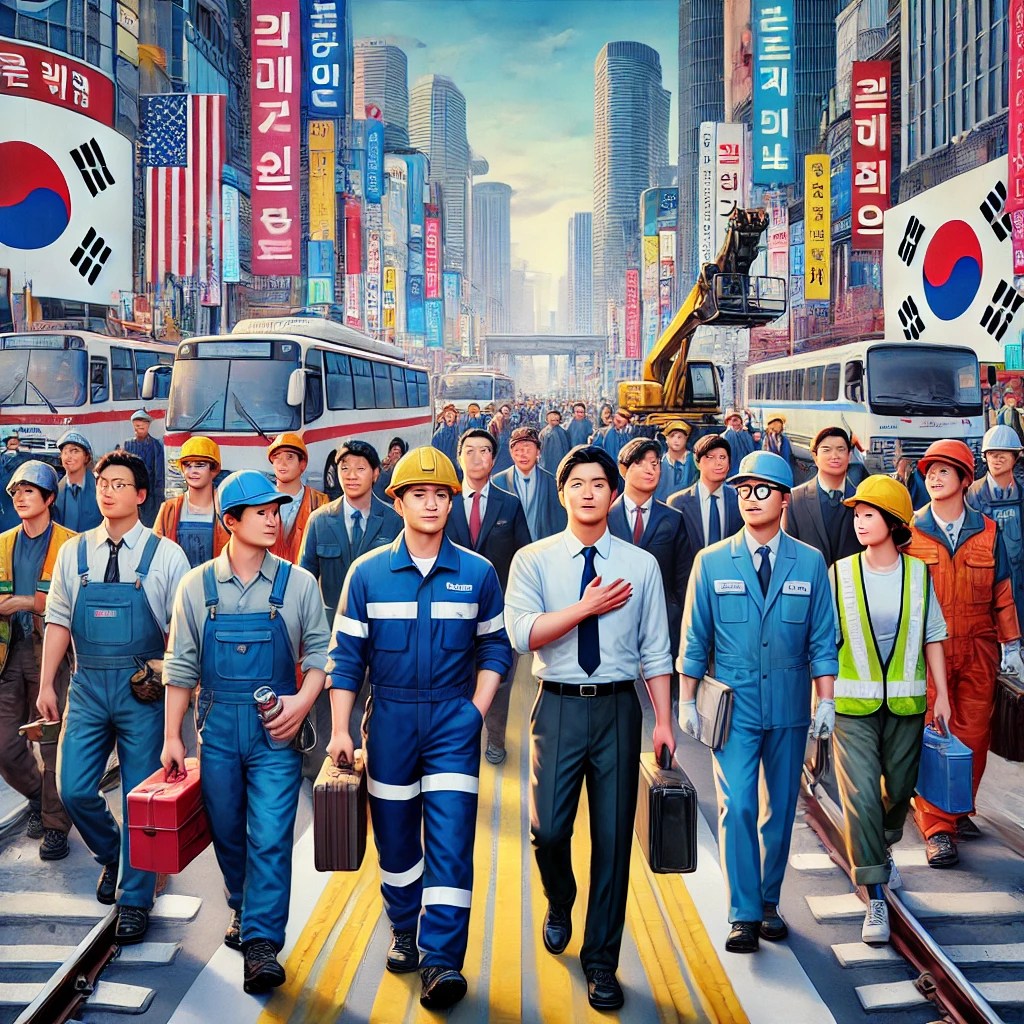
The Cambridge Dictionary defines ‘Blue-Collar’ as relating to people who do physical work rather than mental work, and who usually do not work in an office. From the first usage of the term to the present day, the term has seen significant growth in its definition. Prior to the Industrial Revolution of America, the majority of Americans were farmers, while after it, the majority worked in factories. The Industrial Revolution not only changed America’s economy and culture, but it changed the underlying industry that was the heart of American society.
After industrialization had fully begun to run its course through all (at the time) 26 states of America, the entirety of America’s population could be lumped into 3 general groups; the rich, the poor farmers, and the poor factory workers. In the late 18th century through to the beginning of the 20th century, those who weren’t generationally wealthy were often generationally poor. When everyone is a blue collar worker, no one really is.
It was not until the early 20th century that a middle class began to form. The popularization of office jobs that were suited to a marginally better-off middle class as opposed to their less economically fortunate brothers, meant that there was now an even greater divide between America’s economic classes. The word was created to differentiate between the two. While in recent years, the word has taken on a somewhat different meaning, at its root the word refers to those who worked in factories and were therefore less well off. It is, most likely, from here that the word began to have a negative connotation. Historically, those considered blue-collar workers were paid significantly less and were considered to be suited for those with physical strength, rather than those with mental prowess.
The modern world was built on the principle that with hard work and dedication, anyone can get to the top. With a sharp rise in those who pursued higher education in the mid-to-late 20th century and an even sharper rise in first-generation graduates, America’s culture shifted to a majority of citizens striving to hold jobs that were not associated with the tag ‘blue-collar’. This is even more true in South Korea. In Korea, substantial value is attached to success in academics, and the ability to ‘escape’ from the age-old cycle of generational mediocrity. Perhaps due in part to Korea’s unprecedented rise from an undeveloped nation to a technological and economic powerhouse; white-collar jobs being superior is an opinion that is deeply ingrained in Korean culture. Korea’s high school academic structure and style is notoriously rigorous, causing most students to be very well prepared for higher education.
However, this shift has led to a lack of people qualified to take up the ‘Blue-Collar’ jobs of the past. Taking into consideration the law of supply and demand, due to a lack of people able (or willing) to take up the blue-collar jobs in Korea, the average salary of these workers has skyrocketed considerably. Therefore, for jobs that were once considered second-rate in terms of quality and salary, in many modern circumstances blue-collar workers make more, or at least similar amounts of money as traditional white-collar workers. From this arises the modern question of what truly constitutes a blue-collar worker. In addition, for traditionally blue-collar jobs such as electricians, more education is needed for these jobs than ever before.
It seems that in the modern era, a new definition is needed for an ever growing brand of those making great wages with jobs that were once considered inferior.
January 10th, 2025
Columnist Noah King
 Hands to Work
Leave a comment